
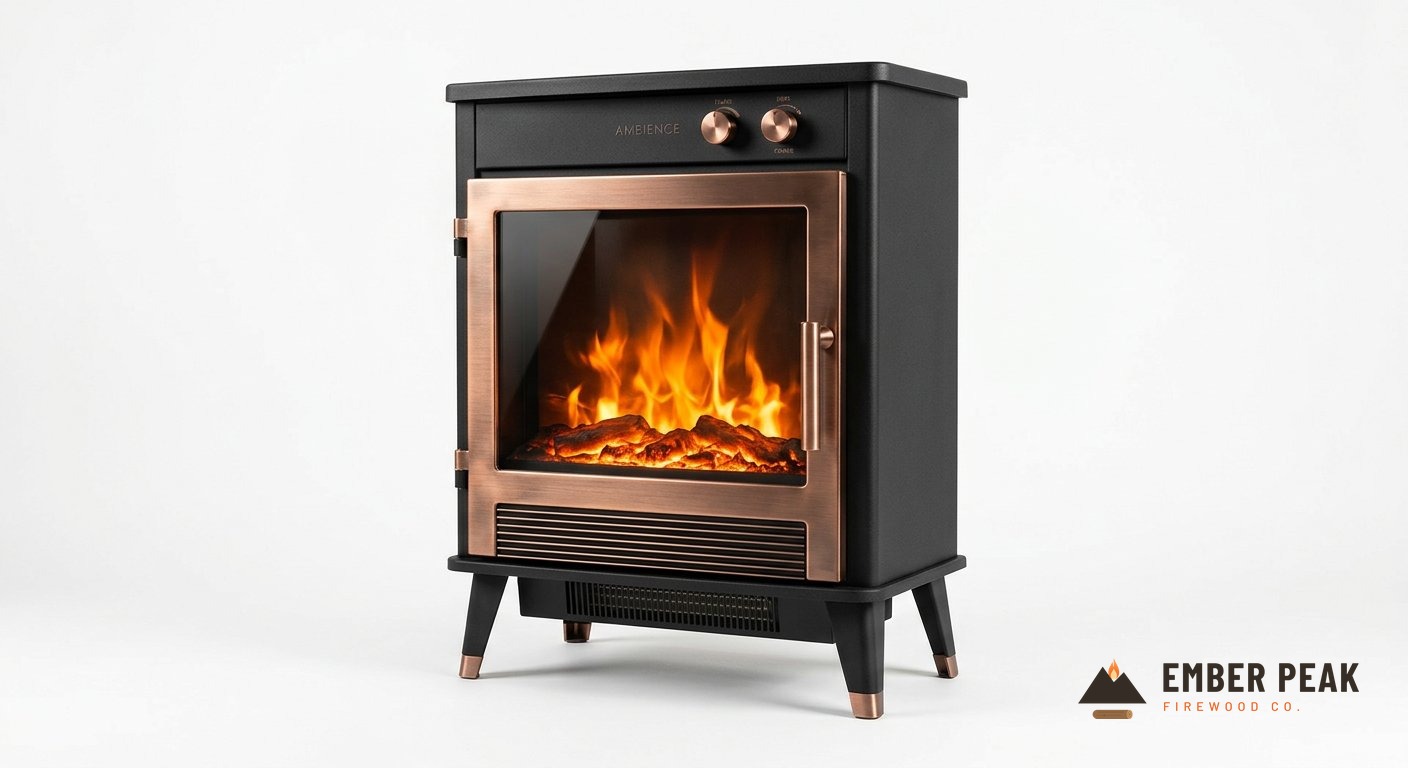
An infrared electric stove heater warms objects and people rather than the air around them. That single difference explains why the Copperfield feels warm the moment you switch it on, instead of twenty minutes later.
It also explains why the room stops feeling stuffy. Infrared does not strip moisture the way forced convection does.
Infrared electric stove heater at a glance
- Three quartz infrared tubes behind a steel heat exchanger
- 5,200 BTU from 1,500W, the practical maximum for a 120V circuit
- Instant radiant warmth with a whisper-quiet blower
- Matte black body with brushed copper door trim
- Digital thermostat, remote, nine hour timer
- 34kg and freestanding, with no venting required
Most cheap electric heaters use a wire coil and a fan. This one uses quartz tubes, which is a different technology with a different feel in the room.
How infrared heat actually works
Infrared is radiant heat. It travels in a straight line until it meets a surface, then warms that surface.
You feel it on your skin and your clothes almost immediately. The air around you stays cooler than the objects do, which is why infrared rooms feel different from convection rooms.
Convection heaters work by heating air and pushing it around. That is effective, but it stratifies, and it dries the air as it goes. After four hours in front of a fan heater most people notice the dryness before they notice the temperature.
An infrared electric stove heater avoids that. The warmth is directional and gentle. Sit in front of it and you are warm within seconds.
One caveat. Infrared warms what it can see. Put a sofa between you and the stove and you have blocked your own heat.
Heating performance and coverage
Three quartz tubes span the width of the firebox. A blower moves air across them, so you get radiant warmth plus a little convective circulation.
Output is 5,200 BTU from 1,500W. That is the ceiling for a standard 15 amp household circuit, and any product quoting much more on a normal plug is quoting marketing rather than physics.
In practice the Copperfield holds 400 to 600 square feet comfortably. It helps up to about 1,000 square feet when doors are closed and insulation is reasonable.
- Cold basements: warms the concrete floor, not just the air above it
- Extensions: handles rooms that never quite reach temperature
- Living rooms: direct warmth at the seating area within seconds
- Garage conversions: best paired with a second unit for full coverage
Basements are where an infrared electric stove heater genuinely outperforms convection. Radiant heat warms the floor surface, and the room stops draining warmth out of your feet.
Specifications and delivery
| Spec | Detail |
|---|---|
| Model | EP-ES-COPPER |
| Heat type | Infrared quartz with fan-assisted heat exchanger |
| Heat output | 5,200 BTU/hr (1,500W) |
| Coverage | 400–1,000 sq ft, insulation dependent |
| Power | 120V / 12.5A standard outlet |
| Flame | LED flame, deep ember bed, three flame heights |
| Controls | Digital thermostat, remote, nine hour timer |
| Finish | Matte black steel with brushed copper trim |
| Dimensions | 64cm W × 74cm H × 36cm D |
| Weight | 34kg as shipped |
| Safety | Overheat cut-off, cool-touch glass, tip-over protection |
| Price | $399.00 |
| Delivery | 2–5 business days, flat $50 under $1,000, free over $1,000 |
We bench-test each unit before dispatch. The thermostat gets checked, the tubes get inspected for transit damage, and the flame gets run with the heater off.
Placement and clearances
Place the Copperfield facing the seating area. Radiant heat travels in a line, so pointing it at a wall wastes the best part of the output.
Leave 20cm at the rear and sides, and keep a metre clear in front of the door. That front clearance matters more here than with a convection unit, because the heat is directional and concentrated.
The 74cm height suits a chimney breast or a flat wall. It is tall enough to read as a focal point and short enough to fit under a standard mantel shelf.
Do not tuck it behind a sofa to hide the cord. An infrared electric stove heater that you cannot see is a heater that cannot see you.
Running costs
Full heat uses 1.5 kWh per hour. At the US average of about 15 cents per kWh, that is 22 to 23 cents an hour.
Because infrared feels warm faster, most people run it in shorter stretches than a convection heater. Real-world cost often comes in below the hourly figure, simply because the unit is not on for as long.
The thermostat adds another saving. Once the room reaches temperature, the element cycles off and the flame keeps running.
The DOE’s guide to electric resistance heating is worth ten minutes if you want the underlying maths. Zone heating saves money when it replaces heating rooms you are not using.
Who it suits
It suits cold-natured households. It suits people who have used cheap electric fires and disliked the dry air. It suits basements, extensions and converted garages where the floor is always cold.
It also suits anyone who wants the best-looking firebox in the range. Brushed copper over matte black reads as expensive in a way that black plastic never will.
It does not suit a room where the stove will sit behind furniture. Radiant heat needs a clear line to the people it is warming.
Installation in five steps
Freestanding, plug-in, and about twenty minutes of assembly.
- Unpack and lift the body out with a helper. It weighs 34kg.
- Fit the feet and tighten them fully, since the tip-over switch sits on the base.
- Position it facing the seating area, with 20cm behind and a metre in front.
- Plug into its own 120V outlet. Do not share it with a kettle or another heater.
- Run the flame first, then the heat on low, then high.
Test on low before high. Any rattle from the blower shows up while the unit still moves easily.
Three mistakes to avoid
Blocking the radiant path. A recliner in front of this infrared electric stove heater will absorb the heat you paid for.
Sharing the circuit. At 12.5 amps it sits comfortably under 15 amps, but not alongside a kettle.
Expecting whole-house heat. This is a 400 to 600 square foot heater in practice. Size it for the room you sit in.
Avoid those three and the Copperfield does exactly what infrared is good at.
How it compares to our other stoves
The Cast Iron Electric Fireplace Stove is the traditional silhouette at $329. Same 5,200 BTU, less copper.
The Corner Electric Fireplace Stove fits a right angle instead of a flat wall, and saves floor space doing it.
The Tall Narrow Electric Fireplace trades width for height if your wall space is limited rather than your floor space.
All ten models sit side by side on the electric stoves collection page.
Infrared or convection: which should you buy?
Convection heaters warm the air and circulate it. They heat a whole room evenly, and they take longer to feel.
Infrared heaters warm surfaces and people. They feel instant, and they work best when you sit within sight of them.
If you want a room at a steady temperature all evening, convection suits you. If you want to feel warm five minutes after walking in, infrared wins.
This infrared electric stove heater leans toward the second camp, with a little of the first built in through the blower.
What arrives in the box
You get the body, feet, door handle, remote with batteries and the printed manual. Tools ship with it.
Every unit gets bench-tested before dispatch. We check the tubes, the thermostat and the plug, then wrap it for transit.
Warranty is 12 months on the element and control board. Transit damage gets replaced with a photo and no restocking fee.
Questions go to a human on the contact page, and the running cost guide covers the electricity maths in more detail.
Care and safety
Vacuum the intake grille monthly, since quartz tubes need clear airflow to work efficiently.
Keep the tubes dust-free and never open the housing. There is nothing inside that needs user attention.
Wipe the copper trim with a dry microfibre cloth. Abrasive polish dulls the brushed finish permanently.
Clean the glass when it is cool, using a non-ammonia cleaner. Hot glass and cold cleaner is how crazing starts.
Infrared and humidity
One reason people describe infrared as gentle is humidity. Convection heating warms air and lowers relative humidity as the room temperature climbs.
Infrared heats surfaces instead. The air temperature rises more slowly, and the moisture in it stays where it was.
If you have ever spent an evening near a fan heater and woken with a dry throat, this is the difference you noticed.
It is not magic, and it is not a humidifier. It simply dries the room out less than the alternative.
Who should not buy this one
If you want a stove you can hide behind a sofa, buy a convection model instead. Radiant heat travels in a line.
If you need to heat 1,200 square feet, buy two units or fix the insulation. No plug-in heater wins that fight.
If you are on a tight budget, the Small Electric Fireplace Stove covers bedroom duty for $189.
And if the look matters more than the technology, the Retro Electric Fireplace Stove delivers period styling for less money.
Long-term ownership
There is no fuel to source, so the only consumable is electricity. Nothing needs servicing annually, and there is no flue to sweep.
Dust the intake, clean the glass, and check the cord once a season. That is the entire maintenance schedule for an infrared electric stove heater, and it takes about fifteen minutes across a whole year. Nothing about that schedule changes with heavy use.
The quartz tubes are rated for years of daily use. If one ever fails inside warranty, we replace the unit rather than sending you a part.
Common questions
Does infrared really heat differently?
Yes. It warms surfaces and people rather than the air, so you feel it within seconds and rooms feel less dry. It is still a 1,500W heater, so the running cost is the same.
Can I use this infrared electric stove heater in a basement?
It suits basements well, provided you have a standard 15 amp outlet and clear airflow. Radiant heat warms the cold floor surface directly.
Is the copper real?
Brushed copper-finish stainless trim over a steel door. Real copper would tarnish and cost three times as much.
Will it trip a breaker?
At 12.5 amps it sits comfortably under a 15 amp circuit. Do not share the outlet with a kettle, microwave or another heater.
Does it dry the air out?
Less than convection. Infrared does not strip moisture from the air the way forced hot air does, which is the main reason people prefer it.
One last thing before you buy
Check the outlet. This infrared electric stove heater draws 12.5 amps, which is fine on a dedicated 15 amp circuit and not fine on a shared one.
Check the sightline too. Sit where you plan to sit, and look at where the stove will stand. If a piece of furniture blocks that line, the radiant heat will not reach you.
Those two checks take a minute. They prevent most of the returns we see, and they are the reason we publish clearances as precisely as we do.
After that, the decision is about the room rather than the appliance. Buy the one you want to look at, because it will be there for years.
Order the Copperfield today. It ships in 2 to 5 business days with tracking, and orders over $1,000 ship free. Not sure infrared is right for your room? Tell us the space and we will say so honestly.


Reviews
There are no reviews yet.