
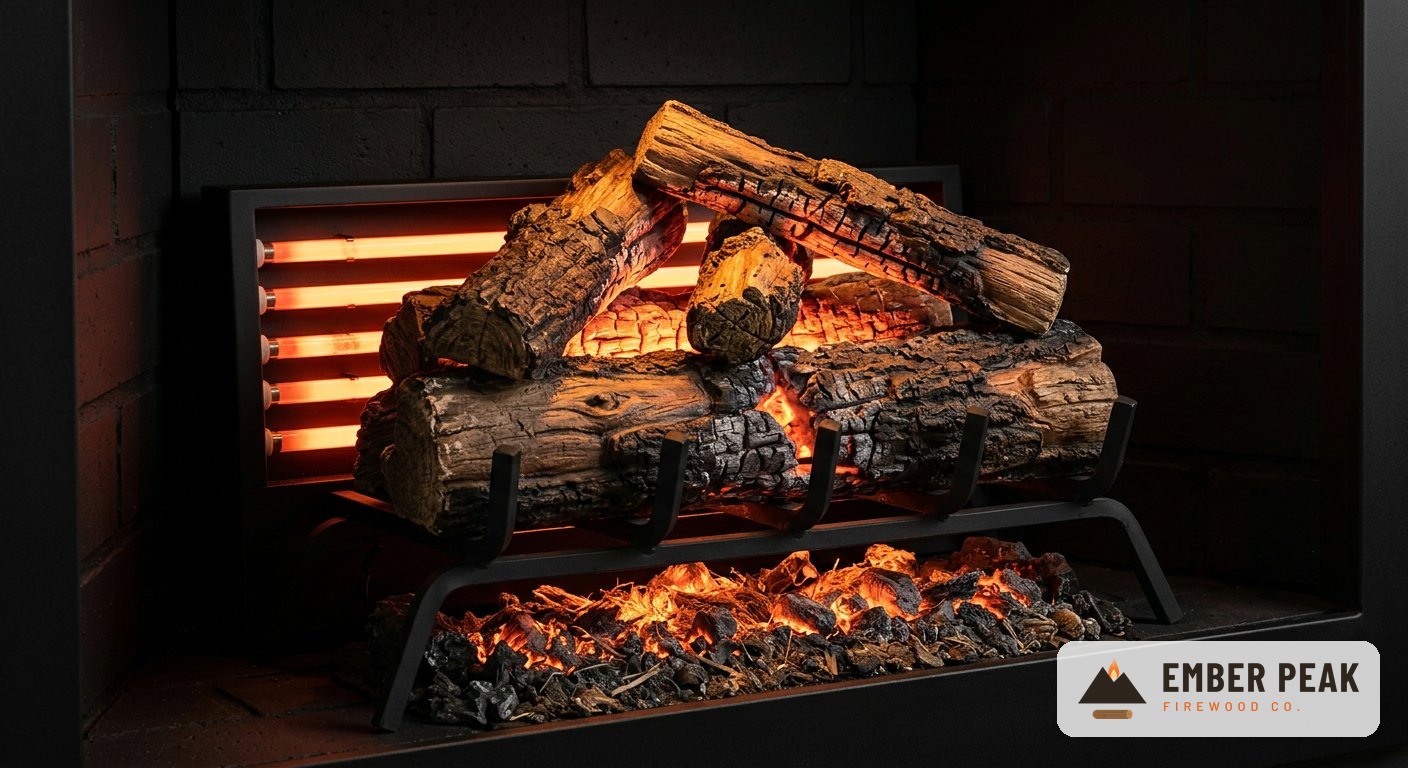
An electric log set with heater is only as good as its heating element. Most use a wire coil and a fan, which works but dries the air and feels harsh.
This one uses infrared quartz tubes. They warm people and surfaces rather than the air, so the room feels warm in seconds and less stuffy after an evening.
Electric Log Set With Heater at a Glance
- Three infrared quartz tubes for instant radiant warmth
- Gentler on room humidity than fan-forced heat
- 5,200 BTU / 1,500W with thermostat
- Charred log detail masks the element without blocking heat
- Flame-only mode for summer
- Remote control and 9-hour timer
Who it suits: Cold-natured households, basements with cold floors, and anyone who has used a cheap electric fire and disliked the dry air.
Infrared versus fan-forced heat
Convection heaters push hot air around the room. Infrared heats the surfaces the light can reach — your skin, your clothes, the sofa, the floor.
The practical difference is speed and humidity. Infrared feels warm almost immediately and does not strip moisture the way forced air does.
Behind three quartz tubes sits the same 1,500W ceiling every plug-in heater works within, giving 5,200 BTU and honest coverage of about 400 square feet.
Heating performance and coverage
Heat comes from a 1,500W element behind the glass, rated at 5,200 BTU. It is deliberately the same unit across the range, because 1,500W is what a normal circuit will carry without complaint.
In practice a electric log set with heater holds a 400 to 600 square foot room comfortably. It helps in rooms up to about 1,000 square feet when the doors are shut and the insulation is reasonable. Open-plan spaces will always need more than one heat source.
The flame runs independently of the heater. Press the flame button and leave the heat off, and the unit works as lighting rather than heating. That is how most owners use it from spring to autumn.
Sizing is the single most common mistake with a electric log set with heater. Buy for the room you sit in, not the whole floor plan, and the unit will cycle comfortably instead of running flat out all evening.
If your walls are uninsulated or the room sits over a garage, treat the rated coverage as a maximum rather than a promise. The thermostat will still hold the room, but it will run closer to full output for longer.
Specifications and delivery
| Spec | Detail |
|---|---|
| Model | EP-LS-IR |
| Sizes | 24, 30 inch |
| Heat type | Infrared quartz, fan-assisted |
| Heat output | 5,200 BTU/hr (1,500W) |
| Coverage | 400 sq ft realistic |
| Power | 120V / 12.5A |
| Flame | LED with ember bed |
| Controls | Remote, thermostat, 9-hour timer |
| Safety | Overheat cut-off |
| Price | From $399.00 |
| Delivery | 2–5 business days, flat $50 under $1,000, free over $1,000 |
We check the flame, thermostat, cord and plug before dispatch, then ship it tracked.
Placement and clearances
Measure the opening three ways before ordering: front width, back width and depth. Tapered period openings catch most buyers out, because the back is narrower than the front.
Leave 5cm behind the set for the cord and the heater intake. If the opening is shallower than 25cm, choose a smaller set rather than forcing a larger one.
Arrange the logs slightly off-centre and leave a gap between the top log and the ones below. The flame needs somewhere to read through, and a perfectly stacked pile looks like a pile rather than a fire.
Running costs
Full heat draws 1.5 kWh an hour. At the US average of about 15 cents per kWh, that is roughly 22 to 23 cents.
The thermostat cycles the element, so a typical evening lands nearer 15 to 17 cents an hour. Flame-only mode draws a few watts and costs pennies.
The Department of Energy explains how resistance heating is priced per kilowatt hour. It is worth ten minutes if you want to compare running costs properly rather than guess.
Installation in five steps
Installation here means fitting, not building. There is no flue, no gas and no vent, so nobody needs a trade for a standard install.
- Unbox and check the glass in daylight before you discard the carton. Every EP-LS-IR leaves us bench-tested, but transit is the one thing nobody controls.
- Fix the wall bracket or base, using studs or masonry anchors. Electric Log Set With Heater units are heavier than they look, and plasterboard alone will not hold one.
- Lift the unit into place with a second pair of hands, then check it sits level before tightening anything fully.
- Connect the power. Most buyers use the supplied cord into a standard outlet; an electrician can hardwire the unit if you want a cable-free result.
- Run the flame for ten minutes before switching on the heater, then bring the heat on low, wait five minutes, and only then go to full output.
The whole job takes about thirty minutes for one person and twenty for two. Nothing needs plastering, cutting or inspecting afterwards.
Choosing the right size
Start with the wall, not the catalogue. Measure the usable width between two fixed points, then subtract 20cm so the unit does not crowd the edge. That figure narrows the range quickly.
We stock this electric log set with heater in 24, 30 inch. All options share the same body height, so the choice is horizontal rather than vertical, and a wider unit reads as more of a feature while a narrower one reads as an accent.
The second measure is the room. A 400 square foot room suits any size. A 600 square foot open-plan space is better served by the wider options, because heat spreads from a wider outlet and the fire itself fills more of the wall.
If you are between two sizes, go up. Buyers who regret size almost always regret buying small, and a unit that is slightly too wide simply looks generous.
Care and safety
Wipe the glass with a non-ammonia cleaner and a microfibre cloth when the unit is cool. Hot glass and cold cleaner is how crazing starts, and no polish will fix it afterwards.
Dust the surround monthly. A matte black finish hides dust well, though it shows pale scuffs under side light. A dry cloth handles both.
Vacuum the intake grille every few weeks. Keep the heater clear of fabric, and never run it with the intake blocked by a curtain or a cushion. The overheat cut-off will protect the unit, but it cannot protect your evening.
What ownership looks like in year three
There is no fuel to buy, no ash to carry out and no flue to sweep. The only running cost is electricity, and the only maintenance is dust and glass.
The LED flame is rated for tens of thousands of hours, which is several years of daily evening use. If an element fails inside the 12 month warranty we replace the unit rather than sending you a part and a diagram.
The finish is the part that needs attention over time. Clean it with warm soapy water rather than abrasives, and it will look the same in year three as it does today.
That is the honest case for a electric log set with heater over a solid fuel fire. It asks nothing of you except a socket and a cloth, and it gives back a room that feels finished rather than half-furnished.
Returns run 30 days on unopened units and every unit carries 12 months of cover on the element and control board. Keep the carton for a week after delivery so we can resolve a transit issue without an argument, and photograph the glass before you recycle the packaging.
Three mistakes to avoid
Buying for the wrong room. A electric log set with heater heats 400 to 600 square feet in practice. Buy it for a bigger space and you will spend the winter disappointed by arithmetic rather than by the product.
Sharing the circuit. At full heat these units draw 12.5 amps. A kettle, a microwave or a second heater on the same outlet will trip the breaker and the fireplace will get blamed.
Blocking the airflow. Twenty centimetres above and below, plus ninety in front. Everybody thinks their room has that space until the furniture goes back in.
None of those are complicated. They are simply the three things that separate a good install from a frustrating one.
Why infrared suits an open firebox
Infrared warms in a straight line out of the opening, which is exactly how a real fire works. Heat reaches the seating area rather than drifting up the chimney breast.
That suits a fireplace geometry. The opening aims the warmth where you already point your furniture.
It also means the room behind you stays cooler, which is usually what you want from a fire. Sit in front of it and you are warm within seconds.
That directional behaviour is the main reason we fit infrared to this model rather than a fan. An open firebox already aims the warmth for you.
Basements and cold floors
Concrete floors stay cold no matter how warm the air gets, because air does not heat mass efficiently.
Infrared handles that better than any convection heater. The floor surface warms directly, and the room stops feeling like it is draining heat out of your feet.
If your fire opening is in a basement, this is the version to buy.
Fan versus infrared in an electric log set with heater
Most electric log set with heater designs use a fan element, and a fan pushes warm air forward in a narrow cone. Infrared radiates instead, so the heat spreads wider and feels warmer at head height. If you have ever sat in front of an electric log set with heater and felt nothing above your knees, that is the fan, not the room.
How it compares to the rest of the range
The Oakridge Electric Log Set uses a conventional fan heater at the same 5,200 BTU.
The Everwood Realistic Electric Log Set prioritises log detail over heat technology.
The Emberline Electric Fireplace Insert gives you a glazed insert rather than an open log set.
The Ember Peak standard
Every log set we ship is bench-tested before it leaves the yard. We inspect the flame with the heater off, check the thermostat, and test the cord and plug, because a fire that arrives with a rattle is one you resent for years.
Delivery arrives tracked within 2 to 5 business days. Shipping is a flat $50 under $1,000 and free over $1,000, with a $150 minimum order. Anything unclear before or after the sale reaches a human on the contact page, and we will tell you when a different model suits your bedroom better.
Compare all of them on the electric log sets page, or read our sizing guide before you commit. Popular alternatives right now: Oakridge Electric Log Set, Birchwood Electric Fireplace Logs, Crackle Electric Fireplace Logs with Sound.
Common questions
How is infrared different?
It warms surfaces and people rather than the air, so you feel it faster and the room feels less dry.
Does it dry the air?
Less than convection. Infrared does not strip moisture from the air in the same way.
Can I use it in a basement?
It is the best version for one, because it warms the floor surface directly.
Is it noisy?
There is a quiet blower. Flame-only mode is silent.
Does it need venting?
No. Nothing burns.
If you are replacing an open fire that no longer works, this electric log set with heater is the least disruptive route back to a working hearth. Nothing structural changes, nothing needs sweeping, and the whole job takes under an hour including the trip to find an extension lead you will not need.
Returns run 30 days on unopened units and every electric log set with heater carries 12 months of cover on the element and control board. Keep the carton for a week after delivery so we can resolve a transit issue without an argument, and photograph the logs and glass in daylight before you recycle the packaging.
Every one of these ships from our own yard rather than a third-party warehouse, which is why we can tell you honestly what fits your opening and what does not. That is also why we would rather talk you out of the wrong size than sell you one and post you a returns label.
Order the Infrared Electric Log Set Heater today. It ships in 2 to 5 business days with tracking, and orders over $1,000 ship free.
Reviews
There are no reviews yet.