
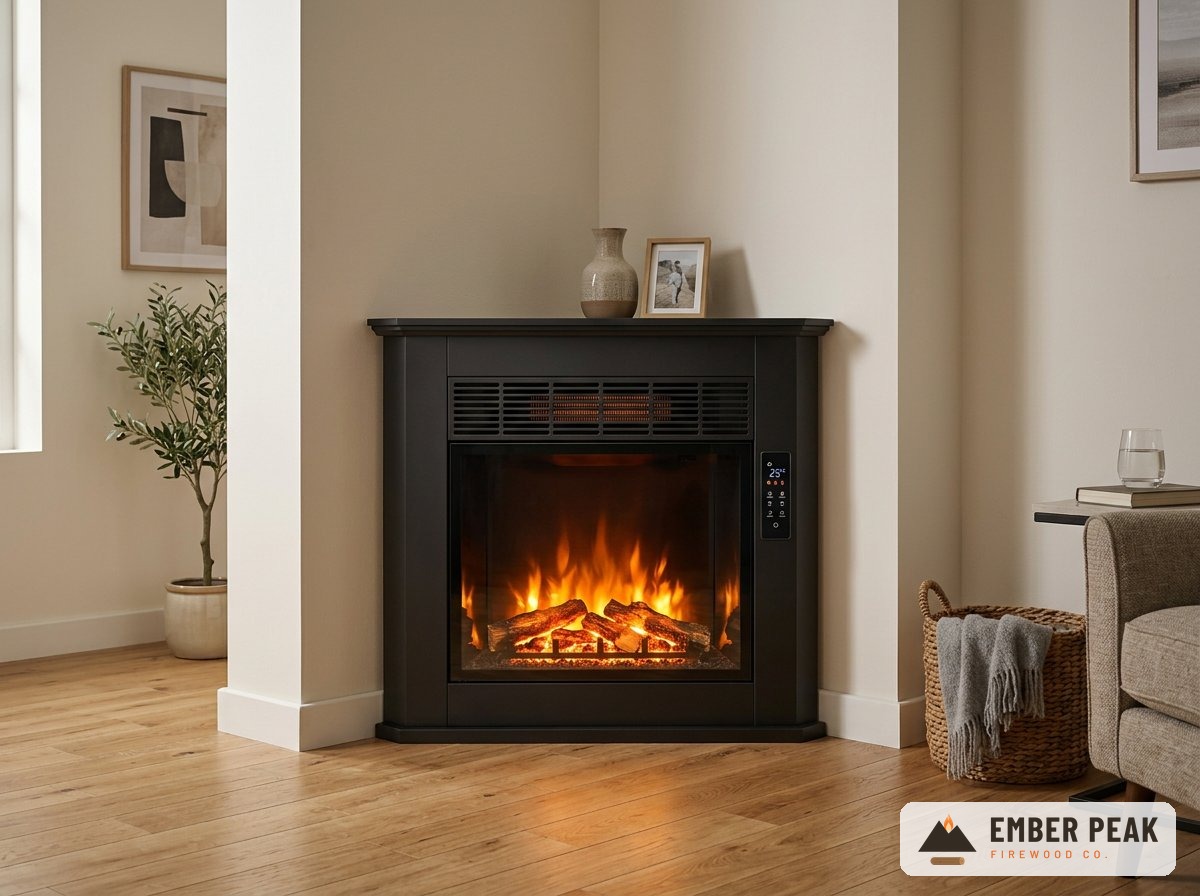
Most electric fires rely on convection, and warm air that leaves a glass front by convection drifts upward and stops. A blower changes that: it moves the air with force, so heat reaches the far side of the room instead of pooling near the ceiling.
The Gale is a corner electric fireplace with blower built for that job, in rooms where the corner is closer to the sofa than to the thermostat.
Corner Electric Fireplace With Blower at a Glance
- Angled outlet that spreads heat along both walls
- Three blower speeds with separate switch
- Runs silently in flame-only mode
- 5,200 BTU element with digital thermostat
- Remote control and 1–9 hour timer
- Overheat cut-off and tip-over switch
Who it suits: a cold corner in an open-plan room, a converted garage or any space where the fire has to work for its place.
What a blower actually changes
A blower is a fan in a housing that pushes heated air through a grille. The difference between a good one and a cheap one is the shape of the airflow and the noise it makes getting there.
On the Gale the outlet is angled, so air leaves across the corner and travels along both walls. In practice that warms the room faster than a straight-ahead outlet, because the heat is spread rather than aimed.
The blower has three speeds and a separate switch, so you can run one flame and no fan, or heat with the fan at the lowest setting, which is the quietest way to hold a room at temperature.
Heating performance and room coverage
The element is a 1,500W fan-forced unit rated at 5,200 BTU. That is the practical ceiling on a standard 120V circuit, and any corner unit claiming more from a normal plug is inventing a number.
In practice a corner electric fireplace with blower holds 400 to 600 square feet comfortably, and helps in a room up to about 1,000 square feet when the doors are shut and the walls are insulated. A corner placement spreads that heat along two walls instead of one, which feels warmer than the number suggests.
The flame runs independently of the heater. Turn the heat off and the fire becomes lighting, which is how most people use it for eight months of the year.
The most common mistake with a corner electric fireplace with blower is buying it for the whole floor plan rather than the room you sit in. Match the unit to the room and the thermostat will cycle calmly instead of running flat out all evening.
Specifications and delivery
| Spec | Detail |
|---|---|
| Model | EP-CORNER-GALE |
| Type | Corner firebox with multi-speed blower |
| Blower | Cross-flow, three speeds |
| Outlet | Angled, spreads along both walls |
| Heat output | 5,200 BTU / 1,500W |
| Noise | 36dB low, 49dB high |
| Controls | Remote, panel, thermostat, 1–9h timer |
| Cord | 72-inch, standard 120V plug |
| Clearance | 25cm above, 5cm each side |
| Sizes | 30 and 36 inch front width |
| Price | From $569 |
| Delivery | 2–5 business days, flat $50 under $1,000, free over $1,000 |
We check the flame, thermostat, cord and plug before dispatch, then ship it tracked.
Placement and clearances
Measure both returns of the corner, from the corner out to the nearest door, window or radiator. The shorter of the two decides which size you can fit, and it is the measurement people forget.
Leave 25cm above the unit and 5cm to each side wall. In front, keep 90cm clear, because a corner gathers furniture and a sofa pushed against the glass will trap warm air and trip the cut-off.
Think about the socket before you commit. A corner electric fireplace with blower needs a standard outlet within 72 inches, and the cord exits on the right of the body. If the nearest socket is on the wrong side, plan a lead or move the socket rather than stretching a cable across a doorway.
Finally, look at what the fire will reflect. Glass on a wall facing a television shows the screen, which is distracting. A corner beside a window reflects daylight in the afternoon, which most people like.
Running costs
Full heat draws 1.5 kWh an hour. At the US average of about 15 cents per kWh, that is roughly 22 to 23 cents an hour.
On the thermostat, a typical evening lands nearer 15 to 17 cents, because the element cycles rather than running continuously. Flame-only mode draws a few watts and costs pennies.
Compare that with a gas fire, which costs more per hour to run in most US markets once standing charges are counted, or with solid fuel, which costs more again and takes an evening to light properly.
The Department of Energy explains how resistance heating is priced per kilowatt hour. Ten minutes there will save you guessing at running costs.
Installation without a trade
There is no flue, no gas and no vent, so a standard install needs no qualified fitter and no inspection afterwards.
- Measure both corner returns and check the unit clears every skirting board and window return before you unpack it.
- Move it into position with two people. Corner units are awkward rather than heavy, and one person will inevitably twist the frame trying to lift it alone.
- Level the feet against both walls. A corner out of square is normal; adjustable feet take up 12mm, which covers almost every room.
- Route the cord to the nearest outlet, keeping it behind the base rather than across the floor where it collects dust and gets kicked.
- Run the flame for ten minutes, then heat on low for five, then full output. If anything rattles at full heat, stop and call us.
The whole job takes about thirty minutes. If you are wall-mounting rather than placing a freestanding unit, add twenty minutes for the brackets.
Choosing the right size
We stock this corner electric fireplace with blower in 30 inch, 36 inch. All options share the same body height, so the decision is about width rather than height.
Start from the wall returns. If both are under 40 inches, choose a smaller body; a wide unit in a short corner crowds the doorway and looks wedged in rather than fitted.
Then look at the room. A 400 square foot room suits any size, while a 600 square foot open-plan space benefits from the wider option, because heat leaves a wider outlet and the flame fills more of the corner.
If you are between sizes, go up. Buyers who regret a corner fireplace almost always regret buying small.
Care and safety
Wipe the glass with a non-ammonia cleaner and a microfibre cloth, only when the unit is cool. Hot glass and cold cleaner is how crazing starts, and no polish fixes it afterwards.
Dust the surround monthly. A painted surround shows dust less than black glass, but it shows fingerprints more, so keep a dry cloth nearby.
Vacuum the intake grille every few weeks and keep fabric away from it. The overheat cut-off will protect the unit, but it cannot protect your evening.
Check the plug and cord once a year for warmth or discolouration. A corner unit is often plugged in behind furniture, where a loose plug goes unnoticed for a decade.
What ownership looks like in year three
No fuel to buy, no ash to carry, no flue to sweep. The running cost is electricity and the maintenance is dust and glass.
The LED flame is rated for tens of thousands of hours, which is years of daily evening use. If an element fails inside the 12 month warranty we replace the unit rather than posting you a part and a diagram.
Returns run 30 days on unopened units, so if the corner turns out to be the wrong corner, you have time. Keep the carton for a week after delivery and photograph the glass before you recycle the packaging.
Three mistakes to avoid
Buying for the whole floor plan. A corner electric fireplace with blower heats 400 to 600 square feet in practice. Buy it for a bigger space and you will spend the winter disappointed by arithmetic rather than by the product.
Sharing the circuit. At full heat these draw 12.5 amps. A kettle or a second heater on the same circuit will trip the breaker, and the fireplace will get the blame.
Ignoring the corner itself. Corners are rarely square, and a unit forced into one will show a gap on one wall for as long as you own it. Adjust the feet, pack the gap, and check with a spirit level before you throw the packaging away.
Using the blower properly
A blower works best when the room is closed. Doors and windows shut, and the fan at the lowest speed that holds the temperature, gives the cheapest result. Turning the blower to full and the thermostat to maximum just moves more cold air around.
If the corner sits beside a doorway to an unheated hall, angle the unit a few degrees toward the room rather than the opening.
When not to use it
Flame-only evenings are better with the blower off. The fan adds nothing to a fire you are running for light, and at the lowest setting you can still hear it in a quiet room.
Overnight, most owners switch the blower off and leave the ember bed on, which is the pattern we would recommend in a bedroom or a small snug.
Blower heat versus radiant heat
A corner electric fireplace with blower warms a room by moving air, which is faster but noisier than a radiant panel. Radiant heat warms objects and people; moving air warms the whole volume of the room. Most buyers want the second, because it reaches the far corner instead of only the person in front of it.
If you sit close to the fire and want warmth on your face, the standard model without a blower is the better buy. A corner electric fireplace with blower suits rooms where the seating is four metres away and the corner is doing the work of a radiator.
Either way, close the door first. A corner electric fireplace with blower pushing warm air into a hallway is a heater warming a corridor nobody sits in.
How it compares to the rest of the range
If you do not need directed heat, the standard corner electric fireplace costs less. If storage matters more than airflow, the corner fireplace with shelves does a different job.
The Ember Peak standard
Every fire we ship is bench-tested before it leaves the yard. We inspect the flame with the heater off, check the thermostat, and test the cord and plug, because a fireplace that arrives with a rattle is one you resent for years.
Delivery arrives tracked within 2 to 5 business days. Shipping is a flat $50 under $1,000 and free over $1,000, with a $150 minimum order. Anything unclear before or after the sale reaches a human on the contact page, and we will tell you when a different model suits your corner better.
Compare the full corner range on the corner electric fireplaces page, or read our sizing guide before you commit.
Common questions
Is a blower the same as a fan heater?
Nearly, but the housing and the outlet shape matter. A blower moves air in a directed stream rather than a diffuse puff.
How loud is it?
36dB on low, which is quieter than a fridge. Full speed is 49dB, audible but not intrusive.
Does the blower run without heat?
Yes, and it is useful in summer for moving air without warming it.
Will it dry the room out?
No more than any other electric heater. Electric heat does not burn oxygen or add moisture.
Can I leave it on overnight?
Yes with the timer set, though most owners use flame-only overnight.
What sizes does it come in?
We stock it in 30 inch, 36 inch. All sizes share the same body height, so choosing one is a decision about width.
Does it include a remote and timer?
Yes. The box includes a remote, an adjustable thermostat, a 1–9 hour timer and the fixings.
If you are replacing an open fire or a gas fire that no longer works, this corner electric fireplace with blower is the least disruptive route back to a working hearth. Nothing structural changes, nothing needs sweeping, and the whole job takes under an hour.
Every unit ships from our own yard rather than a third-party warehouse, which is why we can tell you honestly what fits your corner and what does not. We would rather talk you out of the wrong size than sell you one and post you a returns label.
Order the Gale Corner Electric Fireplace with Blower today. It ships in 2 to 5 business days with tracking, and orders over $1,000 ship free.


Reviews
There are no reviews yet.